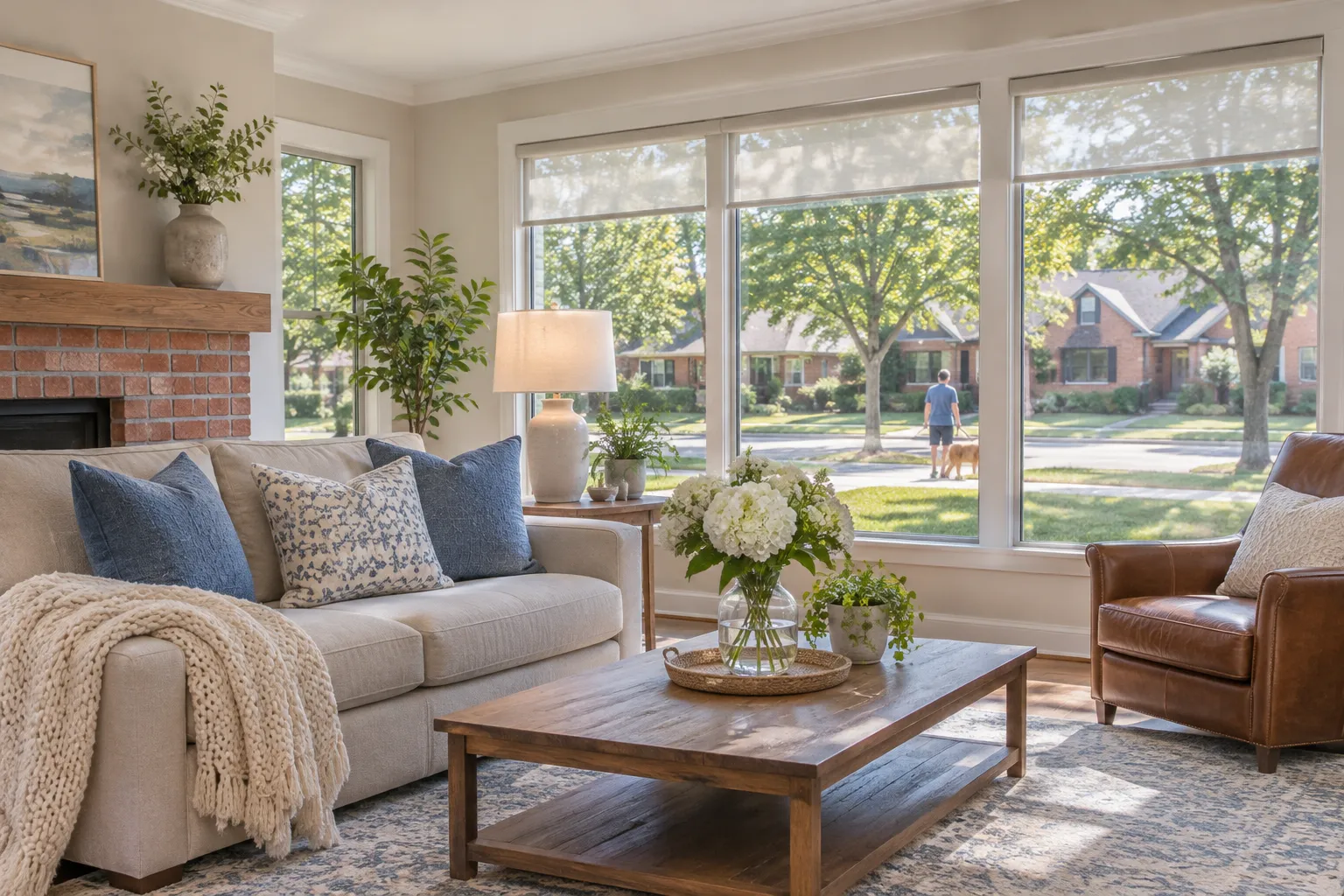
Home window tinting means applying a thin polyester film to the inside of your glass to cut heat, glare and UV, and in some rooms to add privacy. In Oklahoma City, where July afternoons average about 93°F and the thermometer reaches 90°F on nearly 70 days a year, most homeowners tint for comfort first: rooms that stay cooler, furniture that fades less, and screens you can read in the afternoon. This page covers what film does, which type fits which room, what it costs, and how we arrange a visit and a written quote.
Is tinting your house windows a good idea?
For most Oklahoma City homes, yes, on the windows that take direct sun. Good residential film blocks up to 99% of UV, cuts glare and reduces solar heat coming through the glass, so west and south rooms stay more comfortable. It is less useful on shaded north windows, and a few window types need the right film choice to keep their warranty.
The rooms that benefit most are the ones you already avoid in the late afternoon: a west-facing living room, a bonus room over the garage, a sunroom, or a kitchen with a big picture window. Film does three things there:
- Heat. It reflects or absorbs part of the sun's energy before it warms the room. How much depends on the film, the window's direction and how it is installed, so ask for the film's solar heat rejection figure, not just its darkness.
- UV and fading. Glass stops most UVB but lets UVA through. The Skin Cancer Foundation says UV window film can block more than 99% of UVA and UVB, which also slows fading of floors, rugs and furniture.
- Glare. A lighter film can take the harsh edge off TV and computer screens without making the room feel dark.
The honest trade-offs are on our page about the disadvantages of home window tinting, and the upside in more detail on home window tinting benefits.
Which window film is best for a house?
The best residential film is the one matched to the room's problem. For heat with a natural look, a ceramic or spectrally selective film rejects heat while staying light. For maximum heat and glare cut, a reflective film works hardest. For privacy, frosted or one-way mirror film. For safety, a thicker security film.
| Room problem | Film type to ask about | What to expect |
|---|---|---|
| Hot west or south rooms | Ceramic window film or heat control film | Cooler rooms, little change to the view |
| Strong glare and heat | Reflective window film | Most heat cut, mirrored look from outside by day |
| Bathrooms, street-facing rooms | Privacy window film | Frosted or mirrored, chosen by room |
| Fading floors and furniture | UV blocking window film | Can be nearly clear |
| Break-ins, storm debris, kids | Window security film | Thicker film that holds broken glass together |
Many homes end up with two films: a heat film on the sunny side and a privacy film on bathroom or front door glass.
Should you tint home windows that are double pane or low-e?
Usually yes, but the film has to suit the glass. Double-pane and low-e windows can be tinted, and film makers publish which of their films are approved for which glass. The installer checks the glass type, the window's size and its sun exposure before recommending a film, so the window maker's warranty and the film's warranty both stay in place.
Many newer Oklahoma City houses have double-pane windows, and some have a low-e coating already. That coating cuts some heat on its own, so the gain from film is smaller on those windows and the film choice matters more. We explain the details on tinting double pane windows and window film on low-e glass, and the warranty side on window film warranties.
Special glass gets its own attention: a skylight takes the most direct sun in the house, and a sliding glass door is often the biggest single pane.
What can I put on my windows so I can see out but no one can see in?
A one-way mirror (reflective) film lets you see out while people outside see their reflection, but only while it is brighter outside than in. At night, with lights on inside, the effect reverses and people can see in. For privacy around the clock, use frosted or decorative film, or pair mirror film with blinds after dark.
That day and night difference is the most common surprise with home privacy film, so it is worth deciding room by room:
- Bathrooms and entry glass: frosted film, private day and night, still lets light through.
- Living rooms facing the street: mirror film for daytime privacy and heat control, with curtains at night.
- Bedrooms: frosted film on the lower half, clear glass above, keeps light and privacy.
More on this on one-way mirror film and day and night privacy film.
Should I get 35% or 20% tint on my house windows?
The percentage is visible light transmission: how much daylight gets through. A 35% film lets in more light and looks lighter, while a 20% film is darker and cuts more glare. For most living spaces, a lighter film around 35% to 50% keeps rooms bright; darker 20% film suits media rooms and harsh west glass.
Darkness and heat rejection are not the same thing. A light ceramic film can reject more heat than a dark dyed film, so compare the solar heat rejection and UV figures on the film's spec sheet, not just the shade. Car tint limits under Oklahoma law don't apply to house windows, so the choice is about comfort and looks.
Can I tint my house windows myself, or should I hire someone?
You can do small, simple windows yourself with a kit and patience. Large panes, double-pane or low-e glass, skylights and anything above the first floor are better left to an installer, because bubbles, dust and the wrong film on the wrong glass are hard to undo and can affect warranties.
DIY film from a store is usually thinner and has a shorter life than professionally installed film. Our guide to DIY window tinting vs hiring an installer walks through the tools, the steps and where people go wrong.
How much does home window tinting cost in Oklahoma City?
Published national cost guides put installed residential window film at roughly $5 to $15 per square foot, depending on the film and the job. Basic UV and glare films sit at the low end; ceramic, security and specialty films cost more. Many installers also have a minimum job charge, often around $250.
What moves the price on a house:
- the film type (ceramic and security film cost more than standard film),
- how many square feet of glass, and how many separate panes,
- access: ladders, second-floor windows, skylights,
- removing old film first.
A full breakdown with examples is on home window tinting cost. These are guide prices: you get a written quote after a visit, and nothing starts until you agree to it.
Questions people ask
What is the most popular tint shade for homes?
Lighter films are the most popular choice for homes, because most people want less heat and glare without darker rooms. Films that let through roughly 35% to 70% of visible light are common in living areas, with darker films kept for media rooms or very sunny west glass. Ceramic films are popular because they cut heat while staying light.
Is a 20% tint too dark for a house?
For most living rooms and kitchens, 20% is darker than people expect, especially on cloudy winter days. It works well in media rooms, home offices with screen glare, or harsh west-facing glass. If you are unsure, ask to see samples on your own window: the same film looks different at noon and at dusk.
What tools do I need to tint windows myself?
A DIY job needs the film, a spray bottle with a slip solution, a squeegee, a sharp utility knife with spare blades, a lint-free cloth and a hard card for edges. The glass must be spotless first. Dust and hair trapped under film are the most common reason a DIY job looks poor.
How long does home window film last?
Quality residential film installed indoors typically lasts 10 years or more, and the Skin Cancer Foundation describes UV window film as effective for up to a decade. Life depends on the film, the sun exposure and care: clean it with a soft cloth and a mild, non-abrasive cleaner, and wait the curing time the installer gives before cleaning.
Will window film make my rooms too dark?
Not if you choose a light film. Many heat-rejecting and UV films are close to clear, so rooms keep their daylight. If keeping a bright room matters, ask for a spectrally selective or ceramic film and look at samples on the actual window before deciding.
Read on
- Disadvantages
The real downsides of tinting house windows: darker rooms, night privacy, winter sun, glass and warranty risks, looks, HOA rules and cost,…
- Benefits
The real benefits of tinting house windows: cooler rooms, less glare, UV and fade protection, privacy, safety and comfort, with what each…
- Costs
What it costs to tint house windows in Oklahoma City, by room, window type and film, with guide prices per square foot and ways to keep…
- Skylight film
Why skylights overheat rooms, which films cut skylight heat and glare, what to check on skylight glass, access and safety, and typical…
- Sliding door film
Window film for sliding glass doors: cutting heat and glare, adding privacy or safety, visibility markings, fitting large panes, and what…
- Double pane windows
Can you tint double pane windows? Thermal stress, seal failure, film-to-glass guidance, warranties and which films suit insulated glass,…
See window tinting oklahoma city for the other services and what they cost.
Sources
- Skin Cancer Foundation, UV window film
- International Window Film Association, UV protection
- International Window Film Association, heat control
- Oklahoma City climate normals, 1991 to 2020 (NOAA data via Wikipedia)
- Published national home window tinting cost guides, checked November 2026
Last changed