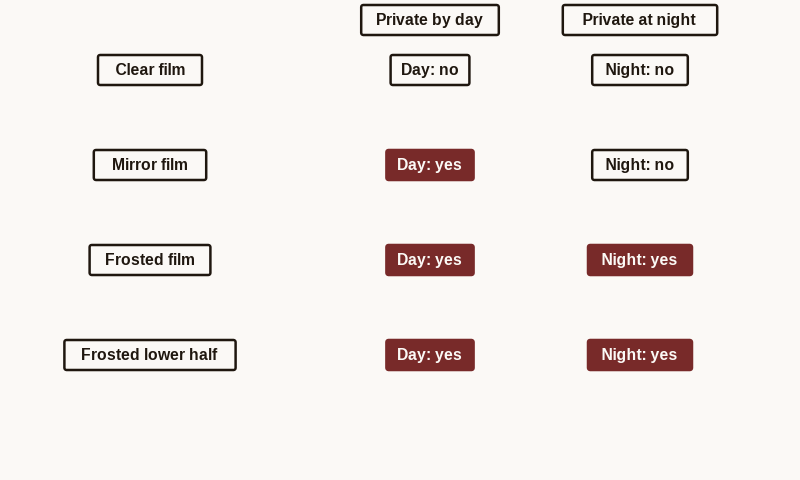
Frosted, etched-look and most decorative films give privacy day and night, because they scatter light instead of reflecting it. One-way mirror film only gives privacy in daylight; at night, with lights on inside, people can see in. Films sold as "day and night" reduce what can be seen after dark but don't make a lit room fully private. So the practical answer for round-the-clock privacy with a view is usually mirror film plus blinds, or frosted film on part of the window. This guide sets out what works, room by room. For an overview of every privacy option, see privacy window film.
Why doesn't mirror film give privacy at night?
Mirror film works by light levels: the brighter side sees a reflection, the darker side sees through. In the day, outside is brighter, so the street sees a mirror. At night with lights on inside, your room becomes the brighter side, so the street sees in and you see your reflection. No clear or mirrored film can change that physics.
That is the most common surprise with privacy film, and it is why choosing for night first avoids regret.
Which window films give privacy at night?
Films that diffuse light give privacy at night: frosted, etched-look, patterned, gradient and opaque decorative films. People outside see a glow and blurred shapes, not detail, whatever the lights are doing. The trade-off is that you can't see out clearly either.
| Film | Day privacy | Night privacy (lights on) | Clear view out |
|---|---|---|---|
| Clear UV or solar film | No | No | Yes |
| One-way mirror film | Yes | No | Yes, by day |
| Dark or dual-reflective film | Yes | Reduced, not full | Darker |
| Frosted film | Yes | Yes | No |
| Decorative patterns | Mostly | Mostly | Partial |
| Frosted lower half, clear top | Yes, lower half | Yes, lower half | Sky and light above |
What about films marketed as day and night privacy?
Some darker reflective and dual-reflective films are marketed for day and night privacy. They are darker and less reflective on the inside, which makes it harder to see in at night than with ordinary mirror film. But with your lights on and the street dark, people can still see movement and shapes. Treat them as reduced visibility, not full privacy.
If you are considering one, ask to see a sample at night with the room lit, viewed from outside, before you buy.
How can I keep a view and still have night privacy?
Combine two things. The simplest options are mirror film for daytime privacy and heat plus blinds or curtains at night; frosted film on the lower half of the window with clear glass above; or a gradient film that is frosted at eye level. Switchable smart film is the high-cost option that does both on one pane.
Common combinations by room:
- Living room on the street: mirror film plus sheer or blackout curtains for evenings.
- Bedroom facing neighbors: frosted lower half, clear top for sky and light.
- Bathroom: full frosted film. See bathroom privacy window film.
- Front door and sidelights: frosted or decorative film. See glass door frosting.
- Meeting room: switchable film if budget allows; see switchable privacy glass cost.
Can you see through window tint at night from inside?
From inside, light tints are easy to see through at night when it is lit outside, such as a lit street or porch. Darker and mirror films reflect the room back at you at night, making it hard to see out. If you want to see out at night, keep films light and avoid strong mirror films on that window.
Is frosted film too dark for day and night use?
Not usually. Frosted film lets most daylight through and spreads it evenly, so rooms stay bright. Denser frosts let through less. The bigger change is losing the view, which is why a frosted lower half or a gradient is popular where you want to keep the sky.
See frosted window film for densities and finishes.
Questions people ask
Is there a window privacy film that works at night?
Yes: frosted, etched-look and most decorative films keep a room private at night with lights on, because they diffuse light. Mirror and clear films don't. Darker "day and night" reflective films reduce visibility but don't give full night privacy, so check a sample at night first.
How do I stop people seeing in my windows at night?
Use frosted or decorative film on the glass, close blinds or curtains, or both. Mirror film alone won't work after dark with your lights on. A frosted band at eye level, with clear glass above, keeps light and some view while blocking the line of sight.
Can you see through privacy window film at night?
Through frosted film, no: people outside see light and shapes only. Through one-way mirror film, yes: at night with lights on inside, people outside can see in. That difference is the main reason to decide room by room which film to use.
Does one-way film work both ways at night?
It reverses. At night, if it is brighter inside, people outside can see in and you see a reflection. If the room is dark and the street is lit, you can still see out and they can't see in. It depends only on which side is brighter.
What is the best film for a street-facing bedroom?
A frosted or decorative film on at least the lower part of the window, because bedrooms need privacy at night. If you want a view during the day too, use a frosted lower half with clear or mirror film above, and close curtains at night.
This guide is one of many on window tinting oklahoma city.
Sources
Last changed