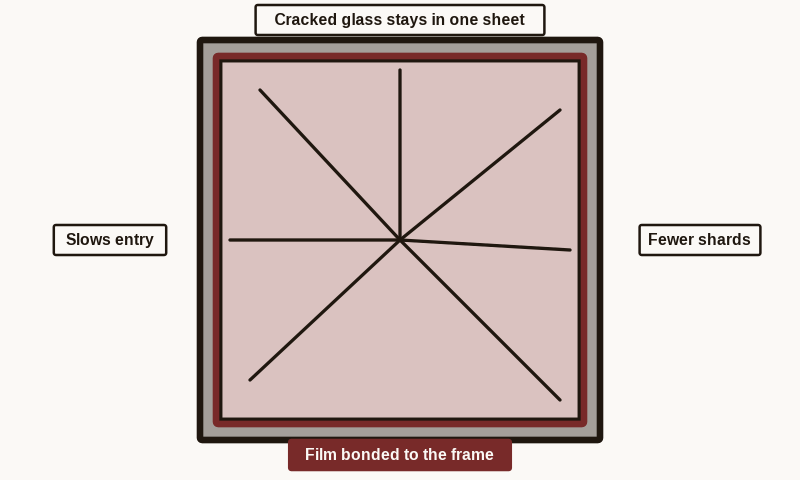
Security film on a sliding glass door holds the glass together if someone breaks it, so getting through takes longer and makes more noise, and broken glass stays in place instead of spraying into the room. Sliding patio doors are large, at ground level and usually at the back of the house, which makes them a frequent target. Film is one layer of protection, best combined with a good lock and a bar in the track. This guide explains what it adds and how to make it count. For security film in general, see window security film.
Why are sliding doors a security weak spot?
Sliding doors combine a large pane of glass, a simple latch, and a position out of sight from the street. An intruder can break the glass and step through, or lift a poorly secured door out of its track. Security film addresses the glass; locks and bars address the frame. Both matter.
Sliding door glass is usually tempered, which shatters into many small pieces when broken. The International Window Film Association notes that properly attached film can help keep tempered glass from falling out.
What does security film add to a patio door?
It turns a quick smash into a slow job. Tempered glass with film may crack but hang together as a sheet, so the intruder has to keep working at it, making noise. It also reduces injuries from accidental breakage, which matters with children and pets running toward the yard.
What it adds, and what it doesn't:
| It adds | It doesn't |
|---|---|
| Time and noise for an intruder | Make the glass unbreakable |
| Less flying glass in accidents | Stop the door being lifted from its track |
| Some help with storm debris | Replace a lock, bar or alarm |
How thick should sliding door security film be?
For a patio door, a security film of around 7 to 8 mil is often used, while 4 to 6 mil films are mainly for accident safety. Thicker films resist longer but are stiffer to fit on a large pane. The right choice depends on the risk; ask the installer to explain why they recommend a given thickness.
A mil is a thousandth of an inch. Cost guides list 8 mil film at roughly $9 to $14 per square foot installed.
Should the film be anchored to the frame?
On a sliding door, anchoring the film to the frame makes a real difference. Without it, a filmed pane can hold together but be pushed out of the frame as one sheet. An attachment system bonds the film edge to the frame so the whole pane stays in place longer. The IWFA notes the system must be matched to the risk.
Anchoring on the sliding panel has to be done carefully so it doesn't stop the door moving smoothly. Guides list attachment systems at roughly $2 to $6 per square foot extra.
What should I combine with security film?
Pair it with a secondary lock or a bar in the track so the sliding panel can't be forced open, anti-lift blocks or screws so the panel can't be lifted out, good lighting on the patio, and an alarm sensor on the door. Film protects the glass; these protect the frame and movement.
Can security film also cut heat on a patio door?
Yes. Many security films come in tinted versions or combined with solar control layers, so a west-facing patio door can get heat, glare, UV and safety protection in one film. That saves filming the glass twice. Ask for a combined product if the door also overheats the room.
See sliding glass door window film for the heat and privacy side.
How much does sliding door security film cost?
A typical patio door has about 35 to 45 square feet of glass. At published guide prices of roughly $7 to $15 per square foot installed, that is about $245 to $675, plus about $2 to $6 per square foot if the film is anchored to the frame. A single door may meet an installer's minimum charge.
See security window film cost.
Questions people ask
Does security film stop someone breaking a sliding door?
It slows them down rather than stopping them. The glass may crack but hold together, so getting through takes time and makes noise, which often deters a quick break-in. A determined intruder with time can still get through, so combine film with locks, bars and lighting.
Is sliding door glass already safety glass?
Sliding door glass is usually tempered safety glass, which breaks into small blunt pieces instead of sharp shards. It is still easy to break and step through. Security film holds those pieces together, which tempered glass alone doesn't do, so the opening stays blocked for longer.
Can I see security film on my patio door?
Clear security film is hard to notice once fitted, though thick film may show a fine edge line. An anchoring system adds a visible bead or strip along the frame. Tinted versions change the look of the glass like any tint.
Can I install security film on my sliding door myself?
It is hard. Thick film on a large pane is stiff to handle, and anchoring systems need careful application, especially on the moving panel. For security film to do its job, professional installation is usually worth it, since gaps and bubbles weaken the bond that holds the glass.
Does security film help in hailstorms?
It can help if hail or debris breaks the glass, by keeping the broken pieces together and in place. It doesn't make the glass hail-proof. It is one way to reduce broken glass inside during severe weather, not protection from the storm itself.
This guide is one of many on window tinting in Oklahoma City.
Sources
- International Window Film Association, safety and security
- Published security window film cost guides (HomeAdvisor, Angi, CountBricks), checked November 2026
Last changed